
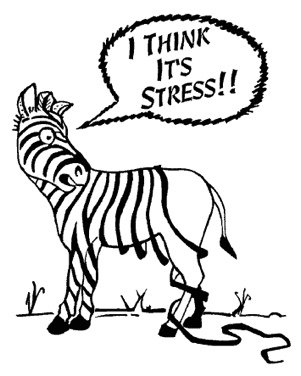
Stress: Using Avoidance to Cope

One level higher than distraction for coping with stress is AVOIDANCE.   As one 14 year old said, “when I don’t want to do something, I go online.”  That is probably true for a number of adults too.  We can get lost in the online world and even have an excuse saying we are doing research or something else.

When it comes to the higher level of avoidance, procrastination is very high on the list of common ways of putting off something that we do not want to face.  Using procrastination on projects, studying or deadlines may be a sign of not wanting to deal with real problems or emotions, and we may find ourselves living with high levels of high anxiety.

Some use sickness as an avoidance strategy.  In the USA over 160,000 students miss school, many times using sickness as the excuse to avoid bullies at school.  It is not that the illness, stomachache, headache, muscle pain or a whole slew of sympton’s are not real – but the root cause may be stress about something deeper that needs to be dealt with that we are avoiding.

Others use sleep as a way of avoiding stressful situations and challenges.  There is no doubt that when we are rested we can do a better job of facing our work, but if we are spending over 12 hours in bed or not leaving our bed on the weekend, it could be a sign of avoiding something.  One thing for sure is that sleep will not solve deeper challenges.

But here is the surprise avoidance tactic of all, being super involved and overachieving to overcome negative feelings.  Staying busy with many clubs, sporting activities and high end class course work may be a sign of trying to prove to yourself and others that you are good enough.  Trying to keep it all together to prove to our else and others that everything is good, can be so difficult and stressful on us that without even noticing things continue to get worse for us.

Avoidance many times leads to seclusion, with your own negative thoughts, that can lead to feeling hopeless and depressed.  Feelings like this may lead to the highest level of non-coping, escape.  We will talk about the dangers of that in our next article.

1. Using distraction as a way to avoid stress

Life Skills: Integrity – Standing Up For What Is Right

Teaching character and life skills to students

Integrity calls for doing what is right even when it is very hard or when there may be results that do not favor yourself.  The link below is about a girl that spoke up when it was difficult, because it was the right thing to do, and the results helped her classmate, but led to her being bullied.  Here is an excerpt from the story.

He’s a seventh-grader at Tripp Middle School in Turner, active in sports and school plays, friends would say a nice guy. And nearly every day classmates called him “fag,” “faggot” and “queer.” Nearly every day someone punched him, at least one time in the crotch. Nearly every day he was ridiculed, harassed, bullied.

Amanda Fields had never seen anything like it in all of her 13 years.
“Random people. People he doesn’t even talk to would come up to him and say, ‘Hey, fag’ or just kind of use very not good language,” the eighth-grader said.

The boy is a friend of hers. For months she watched his torment and feared for his safety. She worried he’d hurt himself if the harassment got too much.  Then, one day this spring, she and a small group of friends told a guidance counselor about all of it. The bullies — more than five, Amanda believes, and less than 15 — were suspended.
Citing student privacy concerns, school administrators refused to talk about the situation or confirm the suspensions. The boy and his parents declined to speak publicly. Other Tripp Middle School students wrote about the incident online, but would not talk about it to the newspaper.

But Amanda would. She agreed to tell the story that started out as the boy’s and has rapidly become her own.  Because since she and her friends told the guidance counselor, Amanda’s gotten bullied, too.

To read the whole story go to:  Standing Up: One Girl, One Friend, Many Bullies

Now I share this story because there will come times when we need that kind of courage.  Each of us can ask ourselves if we have that kind of courage.  Do I have the integrity for the principles, values, ethics, and morals that I stand for, that would make me stand up for what is right, just like Amanda?

Being a good friend is partly about standing up to peer pressure and for what is right.

“If you have integrity nothing else matters, if you don’t have integrity nothing else matters.”  Alan Simpson

Life Skills: Integrity – Your Support System is a Valuable Aid

Teaching character and life skills to students

When we are growing into adulthood, finding our way, one of the most important things that we have is our friends.  All of us have those special people in our lives that we love to talk to and hang out with.  There is a saying that goes with that that says;  “You are who you hang out with.”  Choosing our friends has a great affect on our ability to maintaining our integrity to our morals, values and ethics as well as reaching our goals.

Surrounding ourselves with those that will “expect more from us that we do ourselves”, they will always be an inspiration for being our best and in fact even ‘master’ our life.  Who are the people that can do that for us and with us?  It is going to include those around us that love us and have our best interest at heart, like our parents, friends and other trusted adults who may be an inspiration to you.  Those other adults like teachers, coaches, religious mentor, musicians can help us look at things from different viewpoints and keep us on a good track.

But how can we be sure our friends have our best interest at heart?

  • If at anytime your ‘friends’ ask you to change yourself like your clothes, language, values or morals, or to do other things to fit in with them you may need a new group of friends.
  • If at anytime your ‘friends’ ask you to do drugs with them, steal, fight, treat others mean, you may need to find a new group of friends.
  • If at any time you feel like you are being used, manipulated or changed from who you are, you may need to find a new group of friends.
  • If you feel like your life is out of control, boxed in, not allowed to have other friends or you are not reaching the goals that you have written down, you may need a new group of friends.

Surround yourself with a support system that you can rely on and that shares your morals, values and ethics and you will be much more likely to keep your integrity to yourself.

Life Skills: Integrity – Start With Goals and Mission Statement

Teaching character and life skills to students

If someone were to ask you what your personal goals are would you be able to tell them?  Even more than that, have you written your goals down so that you can review them regularly?  Doing so will have an impact on your ability to stay true to yourself, your values, morals and ethics.

We all know that a goal is only a goal if you have written it down and hopefully told others that you are working to accomplish your goals.  Otherwise it is just a dream, something in your head that you think about from time to time.  But when you write it down, carry it with you, read and think about it in the morning when you start the day and reflect on them at the end of the day –  then they are real goals.

If you know your goal is to have a certain GPA, to be on a particular sports team, to reach certain education level, it will be much easier to resist negative peer pressure and keep your eye on your study habits and physical habits of eating and exercise.  Steven Covey called it “begin with the end in mind”.

Take the time to write down your long term goals, and take it one step further and write out a mission statement for yourself.  A mission statement is simply a bit of writing stating the values you want to live by, what you believe in and your goals for living your life.  Here is one link I found that will give you some steps to writing your own personal mission statement.  

How to Write a Personal Mission Statement

Your writing of goals and a mission statement does not have to be long or real wordy.  It can be as long or short as you feel like making it.  It may change as you grow and that is OK, just be sure it reflects who you are in your quest to live your life with integrity.

Using distraction as a way to cope with stress

In our last report on stress we talked about the 3 different ways that some of us cope with stress in our lives.  They were distraction, avoidance and escapism.  Each of them get progressively more harmful to the person practicing them.  However to some degree the use of distraction can offer short term relaxation and can prove to be helpful, as long as it does not get out of control.

Distraction might be a short break to take a walk, bike ride, physical exercise, reading or other short term activity that gets our mind off the pressure at hand.  The only problem with it is that the breaks can get longer or too many of them and that only leads to not getting the work done and more stress.  Unless we control the distraction as a coping tool it could lead to avoiding the problems all together.

We have to be careful that we are not just using distraction as a means of procrastination.  In the end we still have the same work to do, the same reports to write, and the same problems to deal with, except now we have a little less time.  The signs of avoidance in my next report.

Life Skills: Integrity – Be Prepared to Make Good Decisions

Teaching character and life skills to students

If we are going to stand up to our friends, that is resist peer pressure to do things that are against our own morals, values and ethics, we must be prepared.  This type of preparation is no different than being prepared for a physical attack on ourselves.  As a martial arts student and practitioner we know what we would do if someone were to try to push us, or if someone called us a name, we know how we would react – because we have practiced those things.

The same is true with peer pressure.  We must prepare to defend who we are and what we stand for, so if we are asked to do something we are not comfortable with, we will have the strength to say NO.

So what would you do if you were put in a high pressure situation?  Preparing ahead, knowing what we would say and practicing that answer is part of the key to having the courage to actually do it when that time comes – and it will come.  What type of questions should you be prepared for?

What would you do if you were pressured to cheat or lie for one of your friends?
What would you do if you were being pressured to smoke, drink, or take drugs?
What would you do if your friends were bullying someone in your class or school?
What would you do if someone asked you to text you a picture of yourself?

Knowing the answer ahead of time, practicing it in your head, discussing it with your parents are all ways of being prepared to keep your integrity to yourself.